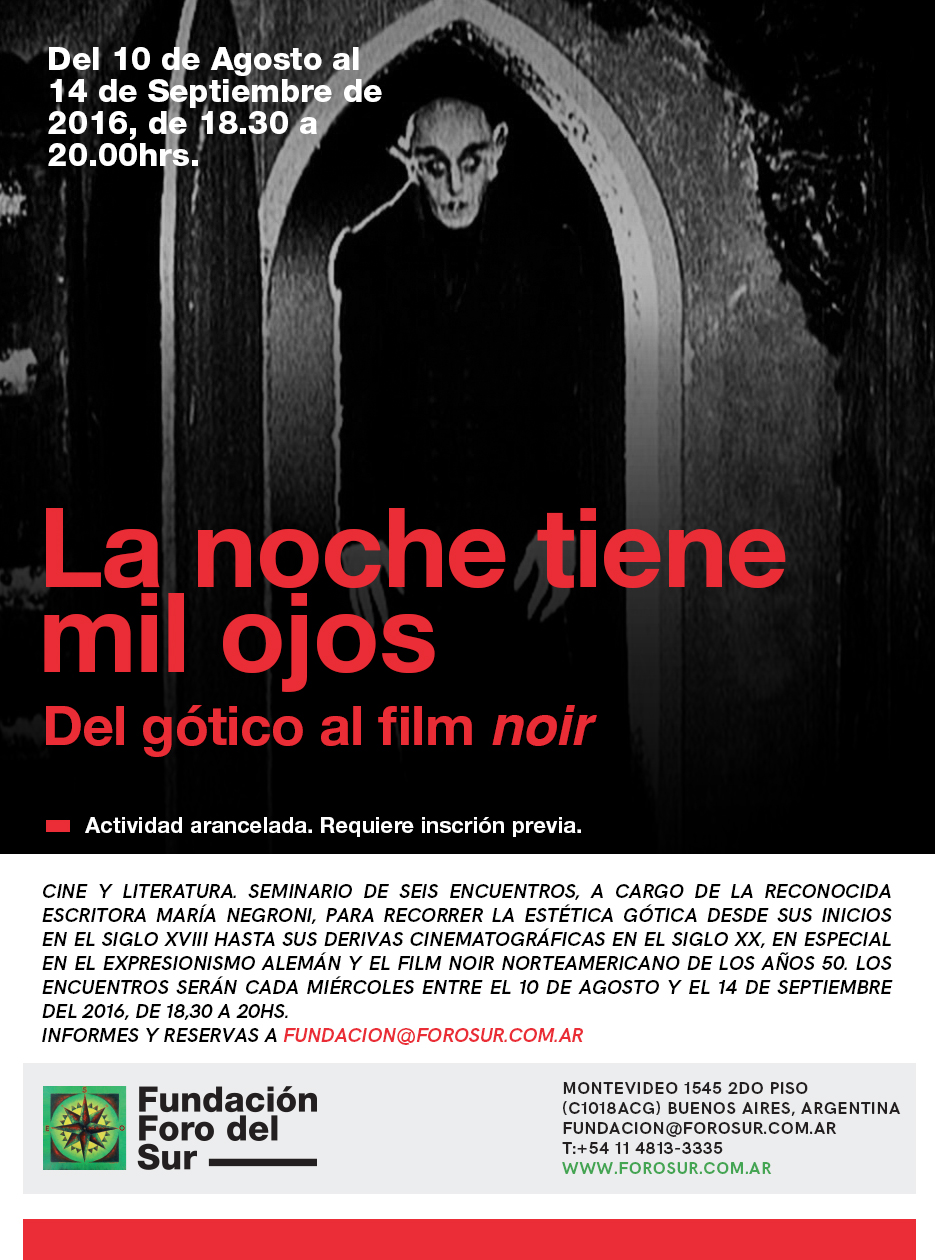
THE NIGHT HAS A THOUSAND EYES. FROM GOTHIC TO FILM NOIR.
10/8/2016 al 14/9/2016
Film cycle with Maria Negroni
The Gothic novel, born in the eighteenth-century England as a crack on the side of the Enlightenment Period, has left persistent marks on European, Latin American and American literature and art.
The purpose of this course is to show how its most conspicuous topics (the black dwelling, the urban phantasmagoria, the predilection for the ruin and the night, the artist's conception as an orphan, a vampire and a criminal, and the endless opus nigrum of creation) reappear with subtle changes, both in the so-called American "black novel" of the 1950s as in the cinema that derived from it – the film noir.
Indeed, in the urban underworld of crime and prostitution, alcohol and loneliness, the culture of cars and wars, where femmes fatales and detectives move, the "detective" manages to unmask the true face of the "American Dream”, with its hypocritical protestant morality and its efficient and individualistic nightmare. This course will attempt to analyze the most outstanding moments of this development, relying on audiovisual and film material to establish links and parallelisms.
Meeting Schedule
Wednesday, August the 10th, from 6:30 to 8:00 p.m.
Introduction. I. The crime scene. The black dwelling. Edgar Allan Poe: The Fall of the Usher House. Horace Walpole: The Otranto Castle. The cursed city of Metropolis. II. Orphans, vampires, doubles, collectors. Bram Stoker: Dracula. Jules Verne: Twenty Thousand Leagues of Undersea Travel. Robert L. Stevenson: Dr. Jekyll and Mr. Hyde.
Wednesday, August the 17th, from 6:30 to 8:00 p.m.
III. Childhood and creation. Gaston Leroux: The Phantom of the Opera. Oscar Wilde: Dorian Gray. Henry James: The Turn of the Screw. IV. Opus nigrum. Mary Shelley: Frankenstein. The Golem. Aliens. Sheridan Le Fanu: Carmilla. Alejandra Pizarnik: The Bloody Countess.
Wednesday, August the 24th, from 6:30 to 8:00 p.m.
Origin and aesthetics of the crime novel and the film noir. Historical and social context. Influence of German expressionism. The recurring topics of the genre. The characters: the night, the detective, the femme fatale and the underworld of the city.
Wednesday, August the 31st, from 6:30 to 8:00 p.m.
Raymond Chandler. Farewell, my lovely (Edward Dmytrik, Murder, My Sweet, 1944 with Dick Powell and Claire Trevor). Dashiell Hammett. The Maltese Falcon (John Huston, The Maltese Falcon, 1941 with Humphrey Bogart and Mary Astor)
Wednesday, September the 7th, from 6:30 to 8:00 p.m.
James M.Cain. Blood Pact (Billy Wilder, screenplay Raymond Chandler, Double Indemnity, 1944 with Fred Mac Murray, Barbara Stanwick, and Edward G. Robinson)
Wednesday, September the 14th, from 6:30 to 8:00 p.m.
James M. Cain. The Postman Always Rings Twice (Tay Garnett, The Postman Always Rings Twice, 1934, with Lana Turner and John Garfield). Tentative conclusions. Persistence of the crime novel and the film noir in literature and cinema.
MARÍA NEGRONI has a doctorate in Latin American Literature at Columbia University, New York. She published numerous books, including: The Night Journey (Lumen), Art and Fugue (Pre-Texts), Buenos Aires Tour (Turner), Joseph Cornell Elegy (Black Box), Interlude in Berlin (Pre-Texts), Black Museum (Grupo Editorial Norma), Fantastic Gallery (XXI Century), Little Illustrated World (Caja Negra), Extraordinary Letters (Alfaguara), The night has a thousand eyes (Caja Negra), The art of mistakes (Broken Glass), The dream of Úrsula (Seix-Barral) and The Annunciation (Seix-Barral).
She has translated works of Louise Labé, Valentine Penrose, Georges Bataille, H.D., Charles Simic, Bernard Noël, and Emily Dickinson. She received numerous recognitions such as the Guggenheim, the PEN American Club New York, the Octavio Paz Foundation, the New York Foundation for the Arts, Civitella Ranieri, the International Essay Prize for the 21st Century, and the Konex Platinum in Poetry (2014). Her works have been translated into English, French, Italian and Swedish. She currently directs the Masters in Creative Writing at the National University of Tres de Febrero in Buenos Aires.